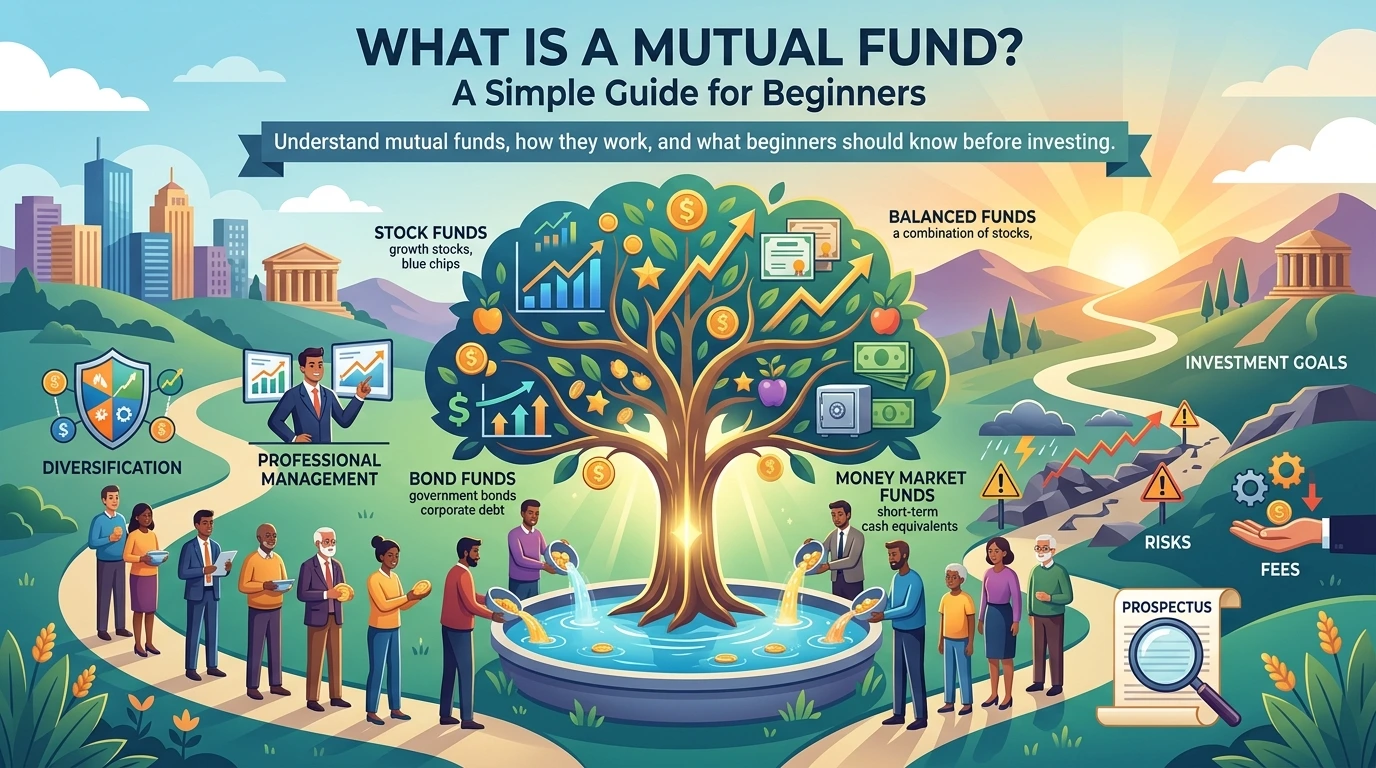
What Is a Mutual Fund? A Simple Guide for Beginners
Learn what is a mutual fund, how mutual funds work, their benefits, risks, fees, and common types in this beginner-friendly guide.
Tagline: Understand what is a mutual fund, how they work, and what beginners should know before investing.
What Is a Mutual Fund? A Simple Guide for Beginners
New to investing? Chances are you’ve heard of mutual funds, but do you know what a mutual fund is and how it is structured?
A mutual fund pools together money from many investors and puts it towards purchasing a wide variety of investments. These can be stocks, bonds, money market instruments, or any other asset. Each investor owns a stake in, and thus is an owner of, the fund.
Before investing, knowing what is a mutual fund is only the first step. Beginners should also understand the fund’s goals, costs, risks, and investment strategy.
Mutual funds become popular because rather than an investor having to purchase and manage a large number of individual investments, funds offer diversification with the added perk of management.
What Is a Mutual Fund?
To understand a mutual fund, you must first understand that it is an investment vehicle similar to a pool. As an example, if many people pooled their money together, a fund would purchase different investment options based on their investment strategy using that pooled money. An adviser would manage that particular fund’s investments.
When a purchase of a mutual fund is made, you would be allocating money to purchase a stake in that fund’s investments. If those investments appreciated, then your stake in the fund has appreciated as well. The opposite would also be true.
According to Investor.gov, mutual funds are SEC-registered open-end investment companies that pool investors’ money and purchase different securities or assets.
If you’re new to investing, understanding what is a mutual fund can help you learn how pooled investments work.
How Do Mutual Funds Work?
Any mutual fund is designed with a particular subjective investment goal in mind. Some funds choose only stocks for long-term growth potential, while others choose primarily bonds to fund income.
When an investor buys a fund share, their money becomes a part of the fund. The fund manager then carries out the fund’s stated strategy. There are three main ways that mutual fund investors are likely to earn a return:
Investments held by the fund pay dividends or produce interest. The fund sells an investment for more than was paid for it, and each fund investor receives a capital gains distribution.
The fund increases in value. The SEC states that mutual fund shares are generally bought and redeemed at the next calculated NAV, subject to applicable fees.
What Are the Main Types of Mutual Funds?
There are a few types of mutual funds, and each serves a different purpose.
Stock Funds
If you choose to invest in stock funds, you will own company shares. Stock funds may focus on growth stocks, dividend stocks, certain industries, or broad-market indexes. However, there is a chance these funds may lose a lot of value.
Bond Funds
These funds hold bonds and other debt instruments. Investors may purchase bond funds for either income or to fill a gap in their portfolio. Bond funds also have risk.
Balanced Funds
As the name suggests, these funds hold a mix of stocks and bonds.
Money Market Funds
These funds hold short-term securities. While investors tend to view money market mutual funds as low-risk options within the mutual fund category, it is important to note that they are not bank deposits and offer no FDIC insurance.
One of the primary reasons for an investment into a mutual fund lies within the freedom of diversification. Instead of a substantial investment into a single company, a mutual fund allows for investment into many companies, in many sectors, in many asset classes.
Another element is that mutual funds allow for professional management. Investment decisions are made as outlined within the fund’s strategy.
what is a mutual fund provide an easy-to-use means of building an investment portfolio for many investors, however, this does not warrant eliminating mutual fund-related investment risk entirely.
What Are the Risks?
Being able to describe what a mutual fund is helps one describe what a mutual fund is not: a guaranteed investment.
When the investments held by the fund lose value, mutual fund values can erode. Mutual funds are subject to stock market risk, interest rate risk, credit risk and many other risks depending on the fund.
Investor.gov notes that mutual funds are not insured by the FDIC or any government agency and that investors risk losing all or part of their initial investments. Past performance does not predict future performance.
Don’t Forget The Fees
Though it may seem minimal, fees charged by mutual funds have the potential to erode the value of an investment over time. Fees associated with mutual funds may include sales charges, redemption fees, and operating costs.
One measure is the expense ratio, which is the fund’s annual operating costs relative to its assets. FINRA suggests that you look at fund costs and the fund’s prospectus before you decide to invest. A strong fund performance may be less attractive if the fund’s costs are higher compared to its peers.
Mutual Funds vs Individual Stocks
When you buy individual stocks, you purchase shares of a particular company. The performance of your investment is correlated with the performance of that one company. A mutual fund buys many different securities with one investment, resulting in one person holding many different securities with a single investment. This type of investment, while still risky, helps to lessen poor performance of one company.
What Should Beginners Check Before Investing?
what is a mutual fund, do not choose one because of recent strong performance.
Consider:
- The fund’s investment goals
- The fund’s investment asset types
- Historical performance
- Operating costs/expenses and associated fees
- Risk assessment
- What type of fund management you are getting
- Investment goals and time horizon that you set
Read the what is a mutual fund prospectus to determine shareholder investment goals and risk tolerance. Aside from the information provided, check out the mutual funds expense calculator and other resources. Pocket Wise Tips and other resources provide other beginner level financial education.
Final Thoughts
So, what is a mutual fund? A mutual fund is a collection of investor contributions that a manager uses to purchase a variety of securities and other investment types. Mutual funds help to diversify investments, but still carry risk and associated costs.The right choice depends on your financial goals, risk tolerance, time horizon, and investment strategy.
Know what the fund holds, what it costs, how it is managed, and how it fits into your overall financial strategy, before you invest. For more investor education, Investor.gov’s Mutual Fund Guide is a great resource.
Now that you understand what is a mutual fund, let’s look at the main types available to investors.
Frequently Asked Questions
What is a mutual fund in simple words?
A mutual fund is a collection of several investors’ money used to buy a group of investments.
Are mutual funds safe?
Mutual funds are not a safe investment. It depends on the securities it holds and investors can lose money.
How do mutual funds make money?
Investors can potentially earn income from dividends or interest, capital gains distributions, or a change in the fund’s NAV.
Do mutual funds have fees?
Yes, there are fees and expenses for mutual funds that vary between different funds. Potential investors should be aware of the expense ratio and any other associated fees.
Can beginners invest in mutual funds?
Yes, investing in mutual funds is safe for beginners, but before investing it is important that investors understand the fund’s strategies, costs, risks, and determine how it will help them work towards their financial goals.
Conclusion
So, what is a mutual fund?